
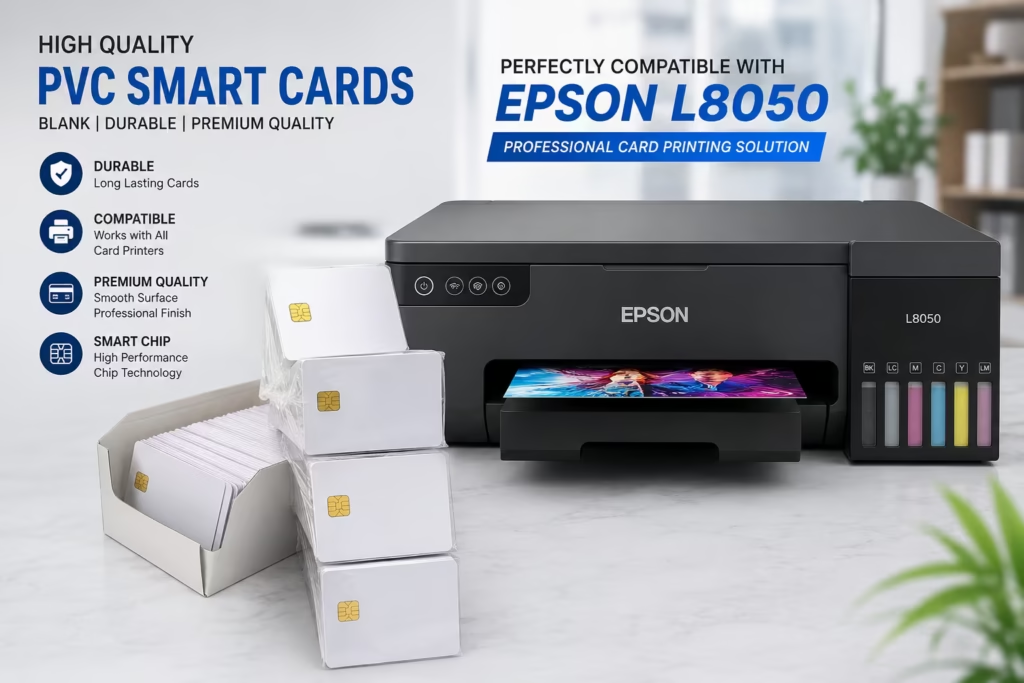
Let me ask you something. How many times have you tapped a card at a metro gate, swiped one at a corporate entrance, or handed one over at a hospital reception? Probably more times than you can count. That small, credit-card-sized piece of plastic doing all the heavy lifting? That’s a PVC chip card — and it’s quietly running the backbone of modern identity, access, and security systems across India.
Whether you’re managing a busy manufacturing unit in Pune, running a private school in Bengaluru, or heading IT infrastructure at an MNC in Gurugram, understanding PVC smart cards isn’t just useful — it’s essential. So let’s get into it, properly.
What Exactly Is a PVC Chip Card?
A PVC chip card (short for Polyvinyl Chloride chip card) is a standard-sized plastic card — the same dimensions as your debit card — embedded with a microchip that stores and processes data. Unlike a plain printed ID card that just displays information, a chip card communicates it. That chip can hold employee data, access permissions, attendance records, payment credentials, and a lot more.
The PVC material makes the card durable, flexible, waterproof, and — importantly — printable. You can put your company logo, employee photo, name, barcode, and QR code right on the surface. It looks professional, it works smart.
Think of it like this: a regular ID card is a business card. A PVC chip card is a business card with a brain.
PVC Chip Card vs. Magnetic Stripe Card: What’s the Difference?
This is probably the most common question, and honestly, a fair one.
| Feature | PVC Chip Card | Magnetic Stripe Card |
|---|---|---|
| Data storage | Up to 8KB+ (chip) | ~140 bytes (stripe) |
| Security | Encrypted, tamper-resistant | Easily cloned |
| Durability | High — chip lasts longer | Stripe degrades with use |
| Use cases | Access, payments, identity | Legacy systems |
| Cost | Slightly higher | Lower |
The magnetic stripe card had its time, but chip cards are now the standard — especially for anything that needs security. Banks, corporates, hospitals, and even schools have made the switch. If your business is still using magnetic stripe cards for access or attendance, you’re living in 2010.
Types of PVC Chip Cards You Should Know
Not all chip cards are the same. Here’s where it gets interesting.
1. Contact Chip Cards
Insert image of a contact chip card showing gold chip contacts on the surface
These are the ones where the chip is physically visible on the card surface — that gold square you see on your SIM card or debit card. The card needs to be inserted into a reader for data exchange to happen.
Used for: Banking, government ID systems, high-security identity verification, SIM cards.
Why businesses use them: Contact chip smart cards offer the highest level of data security because they require physical connection. Great for sensitive environments like data centers, pharma labs, or defense units.
2. Contactless Chip Cards (RFID / NFC)
Insert image of a hand tapping a contactless card on an access control reader
No insertion needed. These cards use Radio Frequency Identification (RFID) or Near Field Communication (NFC) to communicate wirelessly with a reader — just tap and go.
Used for: Office access control, hotel key cards, metro passes, corporate canteen systems, library management.
Why businesses love them: Speed. No fumbling with a reader, no wear and tear. One tap and the employee is in.
3. Dual Interface Cards
Combine contact and contactless in one card. Rare, but used in banking and high-security environments where both types of readers might exist.
4. MIFARE Smart Cards
MIFARE is a specific chip technology by NXP Semiconductors — and it’s arguably the most widely used smart card technology in India right now.
Insert image of a MIFARE PVC smart card used in a campus access system
Used for: Transit systems (Delhi Metro, Mumbai Metro), university campus access, corporate multi-zone entry, canteen payments.
Why MIFARE? It’s fast, reliable, comes in different memory variants (MIFARE Classic, MIFARE Plus, MIFARE DESFire), and has a massive installed base of compatible readers across India.
5. EMV Chip Cards
EMV stands for Europay, Mastercard, and Visa. These are the banking-grade contact chip cards used in all ATM/debit/credit cards issued in India post-2020.
MIFARE vs. EMV — what’s the difference?
| MIFARE | EMV | |
|---|---|---|
| Primary use | Access control, transit | Banking, payments |
| Interface | Contactless (RFID) | Contact (and some contactless) |
| Security level | High | Very high |
| Reader compatibility | Proprietary (NXP ecosystem) | Globally standardized |
Where Are PVC Chip Cards Commonly Used?
Honestly, it’s easier to ask where they aren’t used. But let me give you the actual breakdown for Indian industries:
- Corporate offices & MNCs — Employee access cards, visitor management, attendance tracking
- Manufacturing plants & SEZ units — Zone-restricted access, shift tracking, safety compliance
- Schools & colleges — Student ID cards with library access, bus tracking, canteen cashless payments
- Hospitals & dental labs — Staff ID, patient record linking, restricted-area access (ICU, pharmacy)
- Hotels — Room key cards, gym access, loyalty membership cards
- Retail & membership clubs — Loyalty programs, discount cards, membership verification
- Government institutions — Employee ID, secure zone access
If your organization has more than 20 people walking through doors every day, a PVC chip card system is not a luxury — it’s a necessity.
Can PVC Chip Cards Be Printed and Personalized?
Absolutely yes — and this is one of the best features of PVC smart cards.
Insert image of a card printer producing personalized PVC employee chip cards
You can print:
- Employee name and photo — for ID card personalization
- Company logo and branding — full-colour front and back printing
- Barcodes and QR codes — for scanning and inventory integration
- Serial numbers — for batch tracking
- Holograms and UV printing — for anti-counterfeiting
How Are PVC Chip Cards Printed?
Two main methods are used in India:
- Thermal transfer printing — Most common for professional-grade cards. Uses a heated ribbon to transfer ink onto the PVC surface. Produces sharp, durable prints.
- Inkjet printing on PVC — Cheaper, used for small batches or in-house printing setups. Quality varies by printer.
For best results — especially if you’re printing hundreds of cards for employees or students — go with a dedicated PVC card printer from brands like Zebra, Evolis, or Fargo.
What Chip Types Are Used in PVC Cards?
Here’s a quick reference for procurement managers and IT heads:
| Chip Type | Technology | Memory | Common Use |
|---|---|---|---|
| MIFARE Classic 1K | RFID (13.56 MHz) | 1KB | Basic access control |
| MIFARE Classic 4K | RFID (13.56 MHz) | 4KB | Multi-door, canteen |
| MIFARE DESFire EV1 | RFID (13.56 MHz) | 4/8/16KB | High-security, transit |
| MIFARE Plus | RFID (13.56 MHz) | 2/4KB | Upgrade from Classic |
| NFC (NTAG213/215/216) | NFC (13.56 MHz) | 144B–888B | Tap-to-web, mobile apps |
| EMV Chip | Contact (ISO/IEC 7816) | 64KB+ | Banking, payments |
| HID Prox | RFID (125 kHz) | Basic | Legacy access control |
Pro tip for Indian buyers: If you’re setting up a new access control system, go with MIFARE DESFire EV1 or EV2 — better encryption, future-proof, and compatible with most modern readers. Avoid HID 125 kHz cards for new installations; they’re outdated and much easier to clone.
Standard Thickness: Does It Matter?
Yes, more than you’d think.
The standard thickness of a PVC chip card is 0.76mm (CR80 format) — the same as a standard credit card. This is the ISO/IEC 7810 standard.
Some variants:
- 0.76mm — Standard. Fits all wallets, card printers, and readers.
- 0.50mm — Thinner, used for multi-card holders or bundled passes.
- 1.0mm — Thicker, used for key fobs or more rugged outdoor use.
For corporate or institutional procurement, always specify CR80, 0.76mm unless you have a specific reason to deviate. Anything else causes compatibility headaches.
Are PVC Chip Cards Compatible with Access Control Systems?
This is a critical question — and the answer is: yes, but verify frequency compatibility first.
Most modern access control systems in India work on 13.56 MHz (MIFARE/NFC standard). Some older systems use 125 kHz (HID Prox or EM4100). If you order 500 MIFARE cards for a building that has 125 kHz readers, you’ve just wasted a significant budget.
Before ordering, always check:
- The frequency your existing readers support (13.56 MHz or 125 kHz)
- The specific card protocol (MIFARE, HID, EM4100, etc.)
- Whether the software needs card encoding (UID-based or sector-based)
When in doubt, ask your access control system vendor to provide a sample card for testing before bulk ordering.
How Durable Are PVC Chip Cards?
Very. A well-made PVC chip card will typically last 5–7 years with regular use, depending on:
- Handling frequency — Daily swipe/tap vs. occasional use
- Environmental exposure — High humidity, heat, or chemical exposure can degrade cards faster
- Print quality — Cards without lamination or UV coating fade faster in Indian summers
Durability tips:
- Add lamination during printing for double the lifespan
- Avoid bending cards with chips — the antenna embedded in contactless cards can crack
- Store away from magnets — relevant for combo chip + magnetic stripe cards
- Don’t punch holes through the chip area
For outdoor environments (factories, construction sites, SEZ units), consider PET overlay laminated PVC cards — they handle heat and rough handling significantly better.
Buying Guide: PVC Chip Card Prices in India
Here’s a practical breakdown for procurement teams:
| Card Type | Price Range (per card) | Best For |
|---|---|---|
| Blank PVC chip cards (MIFARE Classic) | ₹15–₹60 | DIY encoding, basic access |
| Thermal printable RFID cards | ₹25–₹150 | Corporate ID + access combo |
| MIFARE DESFire EV1 cards | ₹40–₹200 | High-security, transit-grade |
| NFC PVC cards (NTAG213) | ₹30–₹150 | Mobile integration, smart signage |
| Custom printed + encoded smart cards | ₹65–₹320 | Ready-to-use employee/student cards |
| EMV-style contact chip cards | ₹50–₹250 | Secure identity, fintech applications |
Where to buy in India:
- B2B platforms: IndiaMART, TradeIndia, Amazon Business
- Direct suppliers: Specialize in smart card manufacturing in Delhi, Mumbai, Chennai, Bengaluru
- OEM vendors: If you need 500+ cards, always approach a manufacturer directly for better pricing and custom encoding
For bulk orders (1000+ cards), expect 30–50% lower per-unit pricing compared to small batch rates.
Top 8 PVC Chip Card Products Worth Knowing About
Insert image of a product lineup of different smart card types
Here’s a quick reference for what’s available and commonly procured in the Indian market:
- Blank PVC Chip Cards — ₹15–₹80/card — For in-house printing and encoding
- Thermal PVC Chip Cards — ₹25–₹150/card — Access control and attendance
- MIFARE Classic/DESFire Cards — ₹30–₹200/card — Campus and transit systems
- Contact PVC Chip Cards — ₹40–₹250/card — High-security ID applications
- NFC PVC Cards — ₹30–₹180/card — Mobile-compatible tap applications
- Custom Printed Smart Cards — ₹65–₹320/card — Fully branded, photo + chip
- PVC Access Cards (RFID) — ₹25–₹150/card — Offices, apartments, restricted entry
- Chip + Magnetic Stripe Combo Cards — ₹45–₹200/card — Legacy + modern system compatibility
FAQs: PVC Chip Cards Answered Simply
Q: What is a PVC chip card? A PVC chip card is a standard-sized plastic card embedded with a microchip (contact or contactless) used for identity, access control, payments, or data storage. The PVC material enables full-colour printing and personalization.
Q: Can PVC chip cards be contact AND contactless? Yes — dual interface cards exist that support both. They’re used in banking and multi-reader environments. Most access control cards, however, are contactless-only.
Q: What is a smart PVC chip card used for? Smart PVC cards are used for employee ID and access control, student and campus management, hotel key cards, transit passes, loyalty membership cards, cashless canteen systems, and secure identity verification.
Q: What is the standard thickness? 0.76mm (CR80) — same as a standard credit or debit card. This is the ISO standard for compatibility with card printers and readers.
Q: How long do PVC chip cards last? Typically 5–7 years with regular use. Laminated cards last longer, especially in high-humidity or outdoor environments.
Q: What is the difference between MIFARE and EMV? MIFARE is an RFID-based contactless technology primarily used for access control and transit. EMV is a banking-grade contact chip standard used in debit/credit cards. Both are chip-based but serve different purposes and industries.
Q: Are PVC chip cards secure? Yes — modern MIFARE DESFire and EMV cards use AES-128 or 3DES encryption. They’re significantly harder to clone compared to magnetic stripe cards or older HID 125 kHz cards.
Final Thoughts: Is It Time to Upgrade?
If you’re still managing employee access with basic magnetic stripe cards or printed barcode-only IDs, the answer is a very straightforward yes. PVC chip cards offer better security, more functionality, longer lifespan, and — in the long run — lower total cost.
The good news? India has a robust and growing ecosystem of smart card suppliers, card printer brands, and access control vendors. Whether you’re a 50-person startup in Hyderabad or a 5,000-employee SEZ unit in Gujarat, there’s a PVC chip card solution that fits your needs and your budget.
Start by identifying what you need: access control only? ID cards with photos? Cashless canteen? Tap-to-track attendance? Once you know the use case, the card type, chip technology, and vendor selection become straightforward.
The smart card revolution in India isn’t coming — it’s already here. Your organisation just needs to be part of it.
Have questions about choosing the right PVC chip card for your business, school, or hospital? Drop a comment below or reach out to a verified smart card vendor for a custom quote. And if you found this guide useful, share it with your facilities manager, IT head, or HR team — they’ll thank you.